|
|
| |
|
The
Guinness Book of World Records
After Rosie danced across the Golden Gate Bridge in 1976 and proclaimed
the first Tap Dance Day,the tradition of long distance tap dancing was reborn. Mr. Bill Robinson was known for tap dancing
backward for blocks at a time in his hay day so it was carrying on a rich tradition.
It was only when Rosie
added the Rad Tap Teams and the San Francisco Tap Teams to the mix that the Guinness Book got involved.
Rosie was never interested in establishing a solo record because, she said that it seemed that it would
be practically unverifiable. "Who is to say what
constitutes actual tap dancing. Someone running along with taps
on their tennis shoes could be considered tap dancing and who would be the judge?"
The Guinness Book
folks set effective limits such as a minimum of 10 dancers doing the same thing with no one exiting during the attempt.
When it is a group dancing with predetermined choreography there
is a standard that is much clearer and easier to judge. Since 1978 the Tap Teams have set 8 different long distance
tap records and are the current record holders and it is a lot harder than it looks.
The first concern
is safety. Rosie says,"It is not OK to set a record and injure dancers in the process. We deal with an event that last
(1997) took over 6.5 hours of continuous tap dancing across the city of San Francisco. Our current record distance is 9.6
miles.We could never achieve this if we wore regular tap shoes or used traditional tap technique or choreography."
"We have been able to set and hold these records because
the dancers were all using the deeply relaxed movement known as Loose Ankle Tap®. If they were flexing or pointing their
feet they would not survive without serious injuries and could not go the distance. The choreography was also specially
designed to reinforce the deep relaxation of the legs and feet so these dancers can go for miles."
The rules
for the category included two 5 minute breaks during which the dancers changed shoes and socks. Each dancer had two
pair of specially built tap shoes that insure the correct heel height, secure but free to vibrate tap application, special
padding and room for the foot to expand inside the shoe. Except for an occasional blister they never suffered an
injury even though over three hundred adult dancers have been involved in setting these records . They wore
pedometers for an accurate distance accounting and the routes rarely went in a straight line. These dancers were
trained to navigate stairs, curbs, escalators, ramps and other city realities as they danced. Rosie says,"We never used music. We considered ourselves to be musicians,
so blaring music over the sound of our feet was unthinkable. The goal is not to look like we are tap dancing,
but to actually play the music of the surfaces we encounter".
Some tap dancers and teachers consider this an opportunity
to learn from the year round training in Loose Ankle Tap® at the Tap Dance Room and the door is always open.
Most of the tappers at the Tap Dance Room train in classes and workshops to develop a style that looks, sounds
and feels natural on stage and in auditions. They also come to learn the San Francisco Supershuffle™. This 3-4-5 sounded shuffle is impossible to steal and that makes
it more fun to have. The amazing Supershuffle™ is the proof of Loose Ankle Tap® as it is full body tap.
It just comes out your feet. No wonder the great Honi Coles said "That shuffle is the first new thing I have seen
in 30 years." Their have been 30 Rad Tap Dance Teams that have danced on Tap Day across
the city of San Francisco. Each year they held an event to celebrate San Francisco's Annual Tap Dance Day. It was called
the "Tour de Tap for Clean Air™." They danced across the city from the Ferry Boats on the bay and in
Sausalito up Market Street, into and through the Bay Area Rapid Transit system (BART) around Union Square, onto the Cable
Cars and through downtown. They did this to celebrate tap dancing but also to promote public transit to encourage
people to get out of their cars and bike to work when possible. Current note from Rosie After
30 years we retired the "Tour de Tap" in 2006, We have continued to celebrate Tap Dance Day at the Tap Dance
Room at the Royce Gallery in San Francisco. I built it for tap dancing complete with MIDITAP™ floors and a stage
with perfect sight lines. It is our pot of golden sound at the end of the long bumpy yellow brick road.
Please join us at the Tap Dance Room at the Royce Gallery for more on the Supershuffle™, Loose Ankle Tap® and Tap Day Celebrations.
|
|
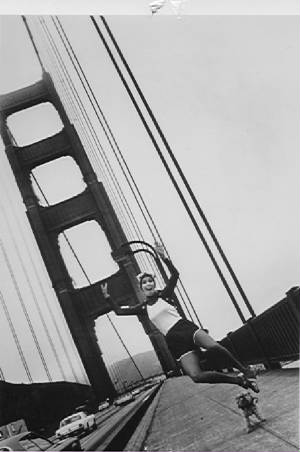
The First Tap Dance Day
Rosie Radiator
and Lu Lu
Golden Gate Bridge
1976
|
| |
|
|
|
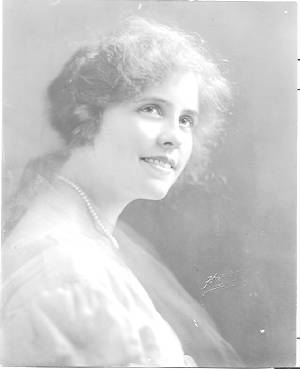
| BESS HESBY HARTSOOK |
|
|
| MISS lIBERTY 1915 |
Miss Liberty 1915
Bess Hesby Hartsook
Queen of the Pan Pacific Exposition
My grandmother
Bess had always been my rock of support.
She would say,” Say it with your dancing dear, people will understand."
Back in 1976 grandmother was suffering from diabetes, which necessitated the amputation of one leg. Across the Golden
Gate Bridge from San Francisco in Mill Valley, my aunt Helen and uncle Thurston were careing for her. In my frequent bedside
conversations with grandmother she confided to me that more than anything else, before she died, she wanted to reconnect with
the wonderful friends she and grandfather had made when he was alive. She said that so many people had made her life a joy;
she just wanted to say thanks.
And what a life it was.
My grandmother, Bess Hesby Hartsook, was "Miss
Liberty", the Queen of the 1915 Pan Pacific Exposition. This world famous international exposition and beauty pageant
celebrated the completion of the Panama Canal and San Francisco's recovery from the 1906 earthquake. As queen, she had a court
of princesses from throughout the world. The Palace of Fine Arts is still today a familiar San Francisco landmark and was
built, in part for her coronation.
My grandfather, Fred Hartsook, was a California rancher and an award-winning
photographer. I saw pictures of him "driving" his team of mules up and down the state pulling the homemade darkroom
wagon that began his career. Eventually he had over 30 Hartsook Photography Studios throughout California.
She
was the beauty queen and he was the photographer, a perfect match. When they fell in love and married they started their family
in Hollywood where still today Hesby and Hartsook streets remain in their honor.
What started out as their honeymoon
cabin grew into the majestic Hartsook Inn, on the Redwood Highway in Humboldt County, California. The Hartsook Inn grew from
the main lodge surrounded by giant redwoods to include over 32 cabins with tennis courts, swimming pools, stables and world
famous clientele. Movie stars including Bing Crosby and Mary Pickford made the long drive from Hollywood to relax in luxury
in the beautiful Redwood Forest. The Inn was also a respite for other artists like Luther Burbank and well known VIP's like
General Pershing. Today, the Hartsook Inn is Owned by the Heartwood Institute.
I knew what my grandmother wanted,
but how could I connect with the people she had known and been so close to? After a visit with her I pondered that question
as I drove back across the Golden Gate Bridge and suddenly her words came to me. "Say it with your dancing..." and
I knew what I had to do.
The next day, after brainstorming in the warehouse with fellow artists Ty, Patty and Hugh
I sent out one press release to the San Francisco Chronicle on golden paper announcing that on Labor Day in the bicentennial
year 1976, I would would tap dance across the Golden Gate Bridge and proclaim it Tap Dance Day in tribute to my grandmother.
As we drove across the city on that foggy Labor Day morning heading for the Golden Gate Bridge I was very nervous.
The last thing I wanted to do was embarrass my Grandmother and I was secretly hoping that no one would notice.
I
was wearing some blue gym shorts borrowed from my brother Jeff, a hat from my brother Mark and neatly folded in my backpack
was the American Flag presented to my grandmother by Mrs. Thomas Edison in 1915. I wore solid sequined gold tap shoes and
danced with my little dog Lu Lu. (She loved to tap too)
As we drove toward the foggy north tower of the bridge
I noticed a large crowd of people and I said, "I wonder what that is all about."
To my great surprise
it was about me. Every news service, major newspaper and television network was there to see me dance across the bridge. From
the China News to the Christian Science Monitor they had all come to cover the story. I told my story to the reporters and
proclaimed it Tap Dance Day 1976 and they followed me as Lu Lu and I danced across the bridge toward San Francisco. When we
got to the San Francisco side of the bridge we unfurled the beautiful flag, I danced as Grimes Polznikov, the Automatic Human
Juke Box from Fishermans Warf, played his trumpet and the sun came out with a rainbow behind us.
I was amazed.
But what happened next was the best part of all. That night the story was shown throughout the world and the next day it was
in all the major newspapers. The reporters told my grandmothers story and they really connected with the life of a tap dancer
as a symbol of true independent labor. Over the next two weeks my grandmother was contacted by over three hundred friends
and acquaintances that she hadn't seen or spoken with since her days with my grandfather. Their words of love and fond remembrance
filled her final days.
When my grandmother died several weeks later she was buried with a picture of me dancing
across the bridge in her honor.
It was in her spirit that Tap Dance Day in San Francisco was established and I
am proud to say that the tradition has continued and this year we celebrate our 30th Annual Tap Dance Day. You were right
grandma, I said it with my dancing and people understood
|
|
|